

Preschool numeracy: 3–5 years
In the preschool years, children develop increasingly intentional mathematical thinking through play and everyday experiences. Between three and five years, children strengthen their understanding of counting, patterns, sorting and classification. Educators support this development through hands on activities, meaningful interactions and intentional teaching. Aligned with the Early Years Learning Framework (EYLF V2.0), these experiences encourage children to develop mathematical understanding, problem-solving skills and confidence in communicating their thinking.

Activity 1: Counting through a pretend shop
Activity overview: Children participate in a pretend grocery store, using play food, shopping baskets, balance scales, and numeral price tags. Educators encourage children to select and count items such as placing two oranges into a basket.
Numeracy learning : This activity develops counting, number recognition and one-to-one correspondence, where children match one word to each object counted. Children also begin to understand that the final number counted represents how many there are in total (Clements & Sarama, 2014).
Developmental suitability: Younger pre-schoolers may count small collections with educator support, while older pre-schoolers may independently count larger collections and match quantities to numerals. The activity can be adapted to individual abilities.
Curriculum alignment (EYLF V2.0): Outcome 4 supports problem-solving through play, while outcome 5 supports mathematical communication as children use number words and explain quantities (Australian Government Department of Education (AGDE), 2022).
Teaching application: I would model counting by touching each item while saying its number. I would ask engaging questions such as, "how many oranges are in your basket?" and I would encourage them to check their answers using the physical objects.
(Clements & Sarama, 2014)

Activity 2: Creating patterns with everyday materials
Activity overview: Children explore repeating sequences using classroom resources such as coloured wooden blocks, threading beads, and collected natural items like pinecones and leaves. Educators demonstrate simple sequences such as red-blue-red-blue (AB and AAB patterns) and they encourage children to copy, continue, and construct their own patterns
Numeracy learning: This activity develops pattern recognition, sequencing, prediction and early algebraic thinking. Children begin identifying repeating units and using these to determine what comes next in a sequence (Clements & Sarama, 2014).
Developmental suitability: Younger pre-schoolers may begin copying simple AB patterns with educator guidance, while older pre-schoolers may create patterns independently or explore more complex sequences, such as AAS patterns. Activities can be adapted using visual, tactile or movement-based patterns.
Curriculum alignment (EYLF V2.0): Outcome 4 supports investigation, problem-solving and mathematical reasoning, while outcome 5 supports communication as children describe and explain patterns (Australian Government Department of Education (AGDE), 2022).
Teaching application: I would model a simple repeating pattern and ask children, "what comes next". I would then encourage them to explain their reasoning and experiment with different materials. For children requiring additional support, I would provide visual examples and reduce the number of materials available.
(Clements & Sarama, 2014)
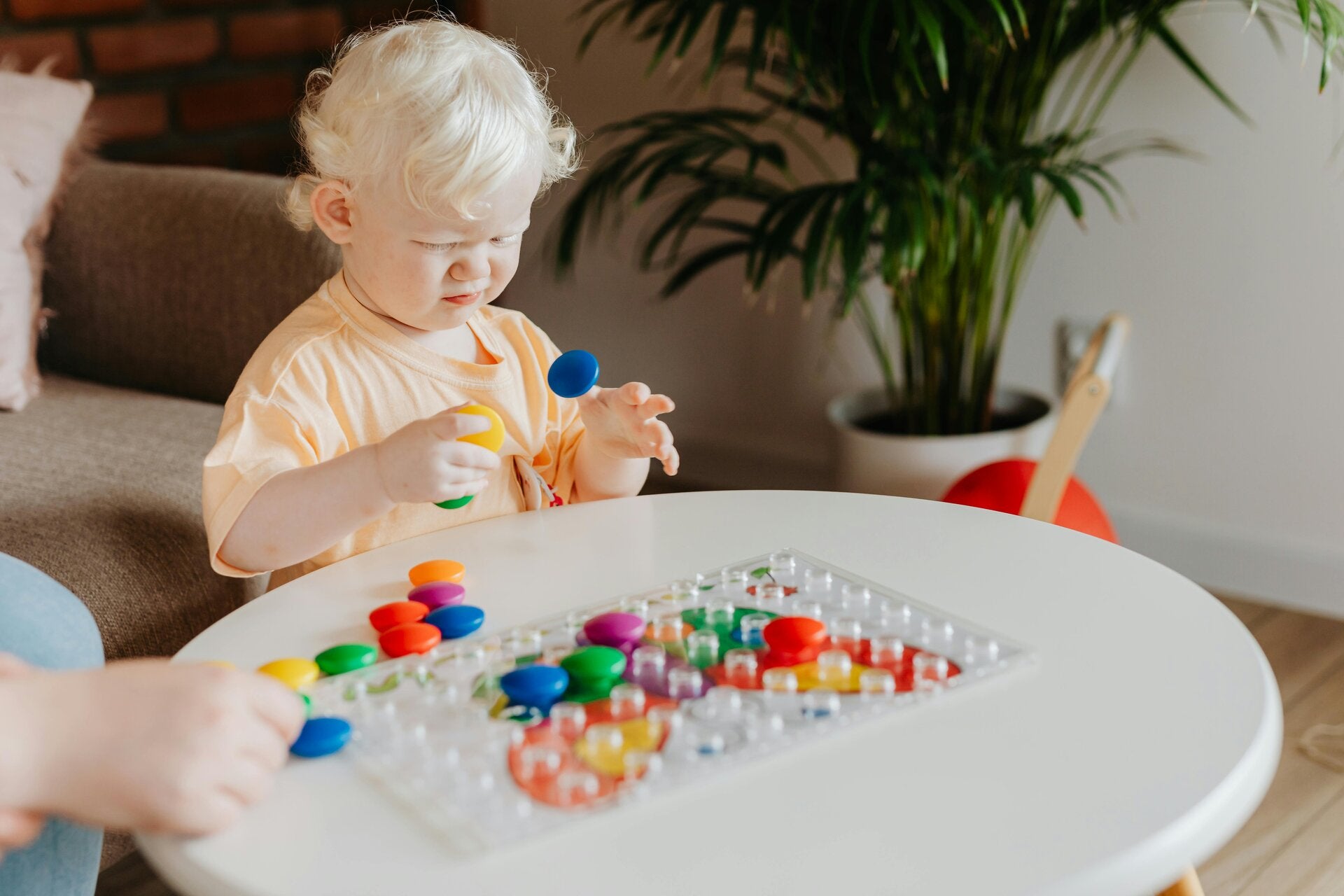
Activity 3: Sorting and classifying everyday objects
Activity overview: Children explore collections of safe everyday materials, such as large coloured blocks, fabric pieces and classroom objects. Educators encourage children to sort materials such as colour, shape, size or texture.
Numeracy learning: This activity develops classification, comparison and early mathematical reasoning. Children learn to recognise similarities and differences between objects and understand that the same collection can be organised in different ways (Clements & Sarama, 2014).
Developmental suitability: Younger pre-schoolers may begin sorting objects according to one characteristic, such as colour supported by educator guidance. Older pre-schoolers may independently sort objects using different characteristics and explain their decisions.
Curriculum alignment (EYLF V2.0): Outcome 4 supports investigation, problem-solving and reasoning, while Outcome 5 supports mathematical communication as children describe similarities, differences and their sorting decisions (Australian Government Department of Education (AGDE), 2022).
Teaching application: I would provide opportunities for children to sort familiar classroom materials during play and everyday routines. I would ask questions such as, "Why do these objects belong together?" and "Are there any other ways to sort them?". I would model the sorting process and provide visual examples for children that require additional support.
This activity develops pattern recognition, sequencing, prediction and early algebraic thinking (Clements & Sarama, 2014)
Create Your Own Website With Webador