

Foundational numeracy for birth to two years
Early mathematical development begins through everyday interactions, sensory exploration and play. From birth to two years, children gradually develop an awareness of numbers, shapes, sizes, spatial relationships and similarities between objects. Educators support this development introducing mathematical language through songs, play-based activities and daily routines. These experiences provide foundations for later mathematical understanding while respecting children's individual developmental abilities.

Counting songs and action rhymes
Activity overview: Educators introduce infants and toddlers to early mathematical language through familiar counting songs and action rhymes, such as Five Little Monkeys Jumping on the Bed. Using finger movements, gestures and repetition, educators encourage children to participate according to their developmental abilities
Numeracy learning: This activity introduces number words, sequences and early awareness of changing quantities. Infants may respond to rhythmic sounds and gestures, while older toddlers may imitate actions and begin repeating number words (Clements & Sarama, 2014).
EYLF V2.0 alignment: This activity supports Outcome 5 (Children are effective communicators) as children respond to rhythmic patterns, pitch, and counting words, as well as Outcome 4 (Children are confident and involved learners) through active participation and anticipation (Australian Government Department of Education (AGDE), 2022).
Teacher application: I would use songs during everyday routines and adapt my interactions to each child's development. For example, I could use finger movements with infants and encourage older toddlers to join in with counting words and actions. This provides opportunities to introduce numeracy through enjoyable, meaningful interactions.

Exploring shapes and sizes
Activity overview: Educators provide infants and toddlers with safe, age-appropriate materials, such as large wooden blocks, soft shapes and nesting containers, to explore through play. As children manipulate objects, educators introduce mathematical language such as big, small, tall, inside and under.
Numeracy learning: This activity supports early spatial awareness, shape recognition and comparison. Children begin exploring how objects differ in size and shape and how they relate to one another in space (Clements & Sarama, 2014).
Developmental suitability: Infants may explore objects through touching, grasping and observing, while toddlers nay begin stacking blocks, fitting objects into containers and comparing their sizes. Materials and activities should be adapted to children's individual developmental abilities and supervised to ensure the safety of the children.
EYLF V2.0 alignment: This activity connects to Outcome 4 (Children are confident and involved learners) through hands-on spatial problem-solving, cause-and-effect experiments, and sensory investigation of geometric properties (Australian Government Department of Education (AGDE), 2022).
Teacher application: I would provide opportunities for children to explore different shapes and sizes during everyday play. Rather than just telling students what objects are, I would encourage exploration and model mathematical language to help them recognise differences and develop spatial understanding and awareness.
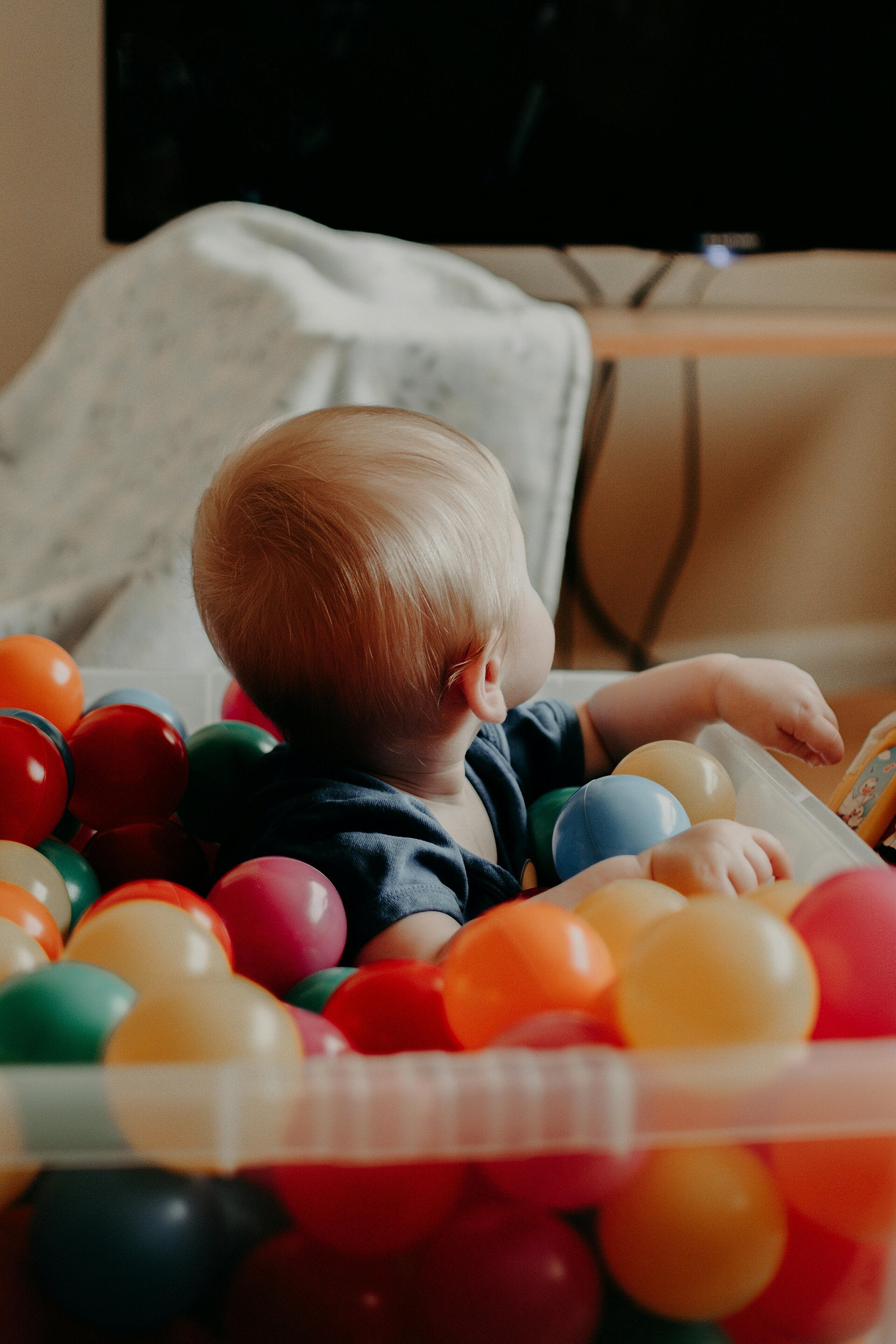
Sorting and matching everyday objects
Activity overview: Educators provide infants and toddlers with safe, age-appropriate everyday objects, such as large blocks, soft toys and stacking cups, to explore similarities and differences. Through guided play, educators encourage children to notice characteristics such as colour, shape and size.
Numeracy learning: This activity introduces early sorting, matching, classification and comparison skills. Children develop an awareness of how objects can be grouped according to shared characteristics, laying foundations for mathematical reasoning and recognising patterns (Clements & Sarama, 2014).
Developmental suitability: Infants may explore objects through touching, observing and grasping, while older toddlers may begin matching or grouping familiar objects according to one characteristic. Educators can adapt the activity to children's developmental abilities by modelling simple comparisons and providing appropriate guidance.
EYLF V2.0 alignment: Directly reflects Outcome 4 (Children are confident and involved learners) by encouraging comparison and curiosity, alongside Outcome 5 (Children are effective communicators) as educators introduce comparative terms such as same, different, and more (Australian Government Department of Education (AGDE), 2022).
Teaching application: I would incorporate sorting and matching into everyday routines, such as organising toys during pack-up time. For example, I could encourage older toddlers to place similar blocks together while introducing mathematical language such as same, different, big and small. This would help children develop early classification skills through meaningful everyday experiences.
Create Your Own Website With Webador